
Online Casino Payment Methods in the UK
 Available in GB
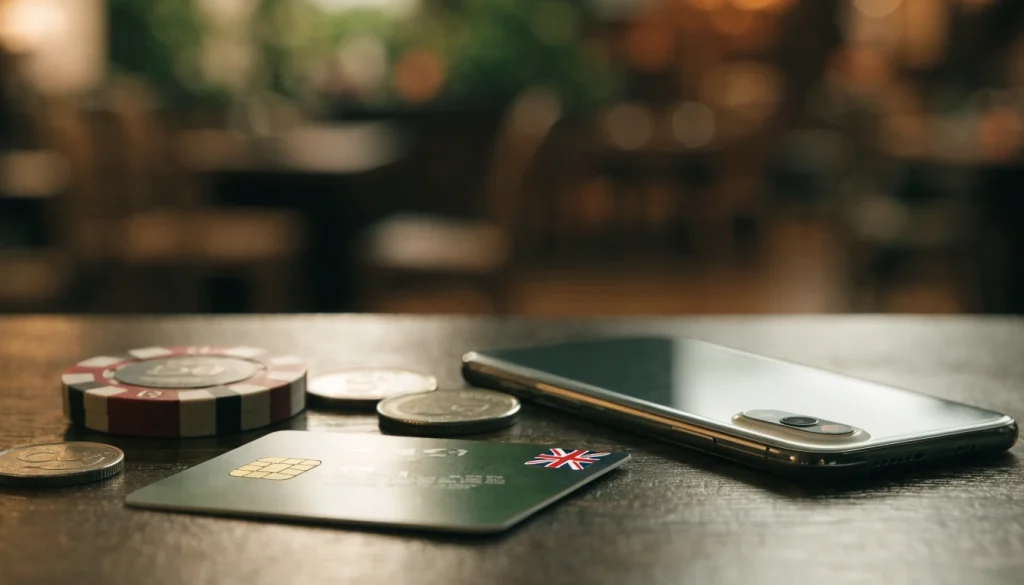
The guide separates the device used to make a deposit from the route that carries the money, including phone billing and account-based options.
Paying from a Phone: Mobile Casino Deposits
A casino played on a phone is not necessarily a casino paid for by phone. The distinction sounds small until the deposit screen appears. A mobile device is simply the place where an account is opened and a payment is initiated; the money may still travel through a route tied to a bank account or another payment service. Phone-bill billing is different: it uses the mobile account itself as the route for charging a deposit. One describes the screen. The other describes the source and path of the funds.
That separation matters because “mobile payment” can mean either thing in ordinary conversation. Someone may be using a phone to make a card or account-based payment, while another person may mean a charge placed against a mobile bill. The same casino website can be viewed on a handset without offering phone-bill billing, and the existence of a phone-bill option does not make every step of the casino experience mobile-specific. The device and the deposit method are related, but they are not interchangeable.
Withdrawal timing is one useful factor to consider when choosing an online casino payment method. The verdicts below highlight the payout-speed information available for each operator.
1. Britsino
Payout speed: 1-3 business days Britsino lists a payout speed of 1–3 business days.
2. x3bet
Payout speed: 1-3 business days x3bet lists a payout speed of 1–3 business days.
3. Amunbet
Payout speed: 1-3 business days Amunbet lists a payout speed of 1–3 business days.
4. BeOnBet
Payout speed: 1-3 business days BeOnBet lists a payout speed of 1–3 business days.
5. SlotoSport
Payout speed: 1-3 business days SlotoSport lists a payout speed of 1–3 business days.
6. Chanze
Payout speed: 1-3 business days Chanze lists a payout speed of 1–3 business days.
7. Dieselwin
Payout speed: 1-3 business days Dieselwin lists a payout speed of 1–3 business days.
8. Revery Play
Payout speed: 1-3 business days Revery Play lists a payout speed of 1–3 business days.
9. NightWin
Payout speed: 1-3 business days NightWin lists a payout speed of 1–3 business days.
10. WinBeast
Payout speed: 1-3 business days WinBeast lists a payout speed of 1–3 business days.
On a smaller screen, the practical work begins before payment. A player logs into an account, reaches the cashier or deposit area, selects an available route and enters the requested information. The layout may be adapted for touch, with controls arranged for tapping rather than clicking. A mobile browser may display the same account functions as a desktop site in a more compact form; an app, where an operator provides one, may present them differently. None of that establishes which deposit routes the operator accepts. The cashier does.
This is one reason the phrase “casino with mobile payment” can be misleading. It may suggest a special kind of casino, when the difference could be only that the ordinary cashier works on a phone. A screen that accepts a deposit from a handset is not proof that the casino supports a charge to a phone account. Conversely, a phone-bill route, where offered, is not a general label for every transaction completed on a mobile device. The description should be read as a question about the route, not the shape of the screen.
The phone also changes how a payment decision is encountered. A deposit can sit close to the game it funds: the account, cashier and slots may all be available in the same small rectangle. That proximity makes the mechanics feel seamless, but it does not make the transaction less consequential. A deposit moves money into a gambling account. The fact that it begins with a tap does not change what the money is for, or remove the need to understand which account or service will be charged.
In Britain, licensed operators must verify a customer’s age before allowing a deposit. They must also prompt new customers to set a financial limit before their first deposit and provide account-level controls for limits. Those requirements apply to the gambling account, not to the size of the screen used to reach it. Mobile design can make controls easy to find or bury them among other menus; the existence of a mobile layout does not itself tell anyone how a particular operator has implemented those obligations.
Casino Bonuses: Free Spins and No-Wager Offers
There is a broader social detail here. The phone has turned the payment counter into something carried from room to room. The old separation between sitting at a computer and going to a cashier has largely lost its physical force: the account can be reached wherever the device has a connection. That convenience is an arrangement of access, not a special payment guarantee. A familiar interface may make a transaction feel routine even when it is still a transfer into a gambling balance.
A useful way to read any mobile cashier is to separate three questions. First, is the casino account being accessed through a mobile browser or app? Second, what deposit route is actually selected? Third, where does that route take the funds from or charge them to? Keeping those questions apart avoids treating every phone-based transaction as phone-bill payment. It also helps explain why two people can describe different experiences as “paying by mobile” while meaning entirely different things.
The distinction carries through to games as well. Slots viewed on a phone are mobile slots in the ordinary sense of being played on a mobile device. That does not mean the game itself supplies a payment route, nor that a particular deposit method is available because the game is. Payment belongs to the account’s cashier; the game is what the balance is used to play. A phone brings them together on one screen, but the categories remain separate.
The small screen is not the method.
SMS Billing and Paysafecard: Payments with a Different Paper Trail
A deposit does not always begin with a bank account. SMS billing and Paysafecard sit at a distance from the familiar card-and-account model, though they do so in different ways. One places a charge on a mobile phone bill or balance; the other uses prepaid value. Neither is simply a smaller version of a bank transfer. Their appeal lies partly in what they leave out of the transaction, and their limitations follow from the same choice.
Newest Online Casinos with No-Deposit Bonuses
SMS billing makes the phone account part of the payment. A charge is authorised through the mobile service rather than entered as a card payment at the casino. That can make the process feel immediate, but the cost does not vanish: it appears through the mobile account. The distinction matters for anyone keeping gambling spending separate from everyday phone use. A payment route can be less visible in a bank statement without being invisible in the household budget.
Paysafecard begins elsewhere. It is a prepaid voucher system: value is obtained in advance and then used to pay at a participating site. The casino does not receive a card number simply because a voucher is used, but that does not make the whole arrangement anonymous or remove the need to understand the account and transaction rules. Prepaid value is still money, and the route’s practical usefulness depends on the operator accepting it and on the terms attached to the payment.
Online Casino with a 600% Bonus: What It Means
That difference can be described as two kinds of paper trail. Phone billing moves the charge into the records of a mobile account; a prepaid voucher separates the initial purchase of value from its later use. Neither erases the underlying spending. The first can be easy to overlook among ordinary phone costs, while the second can make it harder to connect a casino deposit directly to a bank-card entry. The accounting is different, not absent.
A Paysafecard payment at a casino also raises a straightforward question about what happens after a win. A deposit route and a withdrawal route need not be the same. Before relying on a prepaid option, the casino’s cashier information should be checked for the rules governing withdrawals and any alternative verification or payment steps. The label on a deposit button cannot answer those questions by itself.
The same care applies to phone-bill deposits. Their presence on a casino site does not establish that they can be used for every transaction or account. Payment pages describe what the operator currently supports; the relevant terms explain how the route is handled. The method is a way into a deposit, not a complete account of the money’s journey.
Attention: Welcome bonuses may rule out particular deposit methods, including e-wallets. Always read the operator’s offer terms before making a deposit.
Welcome bonuses add another layer. A specialist review of casino offers reports that welcome deals may rule out particular deposit methods, including e-wallets. That is a reason to read the operator’s own offer terms before making a deposit, rather than assuming that every available method qualifies. A bonus can depend on the selected route as well as the deposit itself. The condition is easy to miss.
Security, meanwhile, is not a single property bestowed by a payment label. A route that avoids typing card details into a casino form may reduce one kind of exposure, but account access, the operator’s handling of payments and the user’s own records still matter. “Prepaid” does not mean risk-free; “phone-billed” does not mean cost-free. A safer choice is one whose charges, terms and withdrawal implications can be understood before the deposit is made.
These methods are therefore best understood by the records they create, and by the records they do not. SMS billing attaches a casino charge to a mobile account. Paysafecard draws on value bought in advance. Both differ from bank-linked payments, but neither should be mistaken for a guarantee of privacy, eligibility for an offer or a particular withdrawal experience. The small print remains stubbornly practical.
Casino Payment Methods and the UK Rules Around Them
A casino deposit method is not merely a way to move money. It also determines which financial rules apply, what information passes between services and whether the operator can accept the transaction at all. The familiar categories include bank payments, debit cards, e-wallets, prepaid options and charges routed through a phone account. Each has its own path; none sits outside the rules governing gambling.
UK Casino Cashback Bonuses: Terms and Value
In Britain, remote operators serving customers must hold the relevant licence from the UK Gambling Commission, wherever the operator is based. Online gambling is legal only at licensed and regulated sites, and a legitimate online casino serving UK players must hold a current operating licence. An offshore address does not create an exception. A site may be accessible from Britain without being authorised to offer gambling here.
That distinction matters before a deposit is made. The UK Gambling Commission’s public register is the place to verify an operator’s licence number; a logo or a confident claim on a casino page is not a substitute. Licensed operators must also provide an internal complaints process and access to an approved Alternative Dispute Resolution service. Those obligations are part of the bargain, not decoration around it.
Why credit cards are excluded
The clearest restriction in the payment landscape is the ban on credit-card gambling payments. UK-licensed remote operators cannot accept a credit card for gambling, including when credit-card funds are routed through a money service business. The rule is about the source and use of the funds, not simply the label attached to the final transaction.
A separate restriction applies to digital wallets: operators cannot accept wallet payments where the wallet allows credit-card funds to be used for gambling. A wallet is therefore not automatically a workaround. Its eligibility depends on how it handles funding and whether credit can reach the gambling transaction.
This is one reason that lists of online casino payment methods can be misleading when presented as universal menus. A deposit method may be familiar in everyday shopping yet unavailable for gambling, or accepted only under particular conditions. The casino’s cashier and terms should make the permitted routes clear before money is transferred.
Credit Card Ban
UK-licensed remote operators cannot accept credit cards or wallet payments that allow credit-card funds to be used for gambling.
The account has rules too
Payment regulation begins before the first transaction. Operators must verify a customer’s age before allowing a deposit into a gambling account. New customers must also be prompted to set a financial limit before their first deposit, with account-level limit controls made accessible afterwards. These steps place a pause between opening an account and funding it—a modest friction, by design.
Licensed casinos must provide responsible-gambling tools, including self-exclusion, and operators are required to contribute to the Research, Education and Treatment levy. Those duties help explain why choosing a deposit method is only one part of assessing a casino. A smooth-looking payment screen says little about the protections behind the account.
The UK rules do not declare one category of casino payment method best for everyone. They set the boundaries within which operators can offer deposits, and they require the operator—not merely its payment provider—to meet its obligations. Bank-linked routes, cards, wallets and prepaid methods can differ in practical use, but the same licence test applies to the casino accepting them.
There is a social history in that arrangement. Gambling has long borrowed the ordinary machinery of commerce, then been asked to account for the particular risks of turning money into play. The law draws its line at credit, demands checks before deposits, and makes the licence a condition of lawful operation. Payments may look routine. The permission is not.
Cascading Slot Games in the UK: What to Compare
Apple Pay and Google Pay at Online Casinos
Apple Pay and Google Pay can appear at a casino cashier as digital-wallet options, but their presence on a phone does not make them phone-bill payments. They are separate ways of presenting an underlying payment credential. The distinction matters in Britain, where the rules turn not on the polished interface but on what funds the transaction.
A wallet may hold a debit card, a credit card or another eligible funding source. For gambling, the important restriction is clear: remote operators cannot accept credit-card payments, including credit-card funds routed through a money service business. They also cannot accept a wallet payment if that wallet allows credit-card funds to be used for gambling. A familiar tap-to-pay logo is no exemption.
That leaves a conditional answer to whether Apple Pay works at a casino in the UK, or whether Google Pay can be used at an online casino. The operator must support the wallet, and the transaction must comply with the credit-card restrictions. Availability can differ between operators and accounts; the name of a wallet alone does not establish that a particular deposit will be accepted. The cashier’s terms and the wallet’s funding setup both matter.
The device is not the deposit method
The same casino site can be opened on a phone without using Apple Pay or Google Pay. Conversely, a wallet may be offered through a casino cashier accessed on another device. Mobile browsing describes where the account is being used; a wallet describes how a payment is presented. The two ideas often arrive together, but they are not interchangeable.
A digital wallet describes how a payment is presented, while mobile browsing describes where the account is being used; the two are not interchangeable.
This is one reason the payment screen deserves more attention than the handset. A button marked Apple Pay or Google Pay may lead into a wallet that uses a permitted funding source, or one that cannot be used for gambling under the UK rule. The operator remains responsible for not accepting a prohibited payment. A rejected transaction is not a technical quirk to work around by changing labels or routing; it reflects the boundary set for gambling payments.
These services also should not be confused with a direct bank payment, a prepaid voucher or a charge placed on a mobile bill. Each route has its own relationship to the money behind it. In the case of a digital wallet, the crucial question is whether credit-card funds can reach the gambling transaction.
What the cashier can—and cannot—tell
A casino listing Apple Pay or Google Pay indicates that it offers that route in some circumstances; it does not, by itself, confirm eligibility for every wallet configuration. The payment conditions should explain which funding sources are accepted and whether restrictions apply. If a wallet contains more than one card, the relevant source still matters. Convenience does not dissolve the distinction between credit and debit.
Online Casino with Bonus Crab: UK Offers Explained
A UK casino must hold a current operating licence to serve British players legally. The UK Gambling Commission’s public register is the place to verify an operator’s licence before depositing. That check concerns the operator, not the wallet: a legitimate payment brand cannot make an unlicensed casino lawful, just as a licensed casino cannot accept a prohibited credit-card-funded wallet payment.
The appeal of a digital wallet is partly cultural. It turns a payment credential into a small, controlled gesture, hiding the machinery that once made card numbers visible at every checkout. Gambling regulation restores some of that machinery to view. The source of the money still matters.
The logo is not the rule.
The Range of Casino Payment Options
The list of deposit methods on a casino site can look like a list of interchangeable buttons. They are not. Each belongs to a different kind of financial arrangement, and that arrangement affects whether it is suited to funding an account, receiving a withdrawal, or both. The useful distinction is not simply which logo appears in the cashier, but what role the underlying route plays.
Online Casino 100% Bonus: How Match Offers Work
Debit cards draw money from a bank account rather than a credit line. They are familiar as a way to pay online, though their appearance in a casino cashier does not by itself establish that every card can be used or that withdrawals can return to it. Credit cards are not an alternative for gambling payments in the UK: licensed operators cannot accept them for that purpose. The distinction matters, even when a card and a card-shaped digital wallet look much the same on a screen.
Bank-based routes connect a casino deposit more directly with a player’s account at a financial institution. Some work through a transfer initiated from the operator’s payment page; others involve a separate banking interface. A withdrawal may follow a different process from a deposit, and the available options depend on the operator. The word “bank” describes a connection, not a promise that every transaction will be immediate or reversible in the same way.
E-wallets sit between a bank or card and the gambling account. They can act as a separate balance used for online payments, which gives them a different role from a direct bank transfer. Their eligibility is not automatic: UK rules prevent operators accepting wallet payments where credit-card funds can be used for gambling. A wallet appearing in a general online checkout is therefore not proof that it can be used at a casino.
Prepaid vouchers work from a value loaded in advance. They can make sense as a way to control what is put into an account, but a prepaid deposit route is not necessarily a route for taking winnings out. Phone-bill payments are another distinct category: the cost is charged through a mobile account rather than drawn through a bank transfer or card checkout. That difference in the source of funds can also mean a narrower role in the cashier.
Online casino with 200% bonus: what it means
These categories answer different questions. A deposit method may be convenient for adding funds but unsuitable for receiving them; a method that supports both may still be subject to the casino’s own terms. So the “best” option is not a universal winner. It depends on whether the priority is separating spending from a bank account, using an existing card, or choosing a route that can also handle withdrawals.
How online casino payments work, in practice, is less mysterious than the collection of logos suggests. The operator offers a set of routes, the player selects an eligible one, and the transaction moves through the relevant payment provider before the casino balance changes. The cashier’s terms matter more than the category label: they specify which routes are available for deposits and withdrawals, and whether the same route can be used in both directions.
A broad menu is not the same as a useful one. The quiet detail is the exit route.
UK Bingo Sites and No-Wagering Offers Explained
Trustly and Direct Bank Payments
Trustly sits in the bank-payment part of the casino landscape. Where a card payment uses card credentials and an e-wallet holds or routes funds through a separate account, a direct bank payment is organised around the customer’s bank account. The precise steps depend on the casino and the payment flow it offers; the name of a service alone does not establish that every bank or account can be used.
A Trustly casino payment is therefore not simply another label for a debit-card deposit. The route is bank-based, rather than a charge made through the card network. Nor is it the same as paying through a phone bill: that places the charge with a mobile provider, while a direct bank route involves the bank account. These distinctions matter because a deposit method can shape both how money leaves an account and which withdrawal routes an operator makes available.
The word “direct” can sound more transparent than the process itself. A player may still pass through an operator’s cashier, a payment service and bank authentication screens. The screens and terms should make clear which service is handling the transaction, what account is being used, and whether the route supports withdrawals as well as deposits. A deposit button is not evidence of a matching cash-out option.
Trustly and Revolut
A casino listing Trustly does not necessarily offer it to every customer. Similarly, a financial app like Revolut appearing in a payment chain does not prove a particular casino supports it through Trustly.
For anyone comparing what are the best online casino payment methods, Trustly is best understood by its function, not by a promise of speed or universal reach. Availability can differ between operators and banks, so a casino that lists Trustly does not necessarily offer it to every customer. The same restraint applies to questions about online casinos that accept Revolut in the UK: a bank or financial app appearing in a payment chain does not, by itself, prove that a particular casino supports it through Trustly. The cashier’s current options and terms are the relevant evidence.
The broad question of what are the safest casino payment methods has no answer contained in a brand name. A bank-based route, a card and an e-wallet each place different services between the player and the casino. Safety also depends on the operator and on how the account is protected. In Britain, real-money online gambling belongs at sites holding the relevant UK Gambling Commission licence; the licence number can be checked on the Commission’s public register before a deposit is made. Payment choice does not replace that check.
Online casino reload bonuses: how they work
There is a small social history in the appeal of bank payments. Money once required a visible visit to a counter; now the counter has become a sequence of permissions on a screen. The convenience may be real, but the institution remains present in the transaction. Trustly is a route through that arrangement, not a separate kind of money. A useful distinction.
Neteller and Casino E-Wallet Payments
Neteller is an e-wallet: money is held in a separate account and used to pay a participating online casino, rather than being taken directly from a bank account at the moment of play. That distinction gives the wallet a role between the casino and the original source of funds. It is not the same route as a direct bank payment, even when the wallet balance began in a bank account.
Whether Neteller appears as an option depends on the casino’s cashier and the account involved. Where it is offered, the deposit process generally requires selecting the wallet and signing in to authorise the payment. A casino may also list Neteller among its withdrawal methods, but a deposit option alone does not establish that withdrawals can be returned through the same route. The account’s cashier and terms determine which transactions are supported.
Online Casino with 300% Bonus: How Offers Work
The credit-card boundary
UK rules place a specific condition on wallet payments used for gambling. A licensed operator cannot accept a wallet payment if that wallet allows credit-card funds to be used for gambling. The restriction follows the path of the money, not merely the label on the button. Routing a credit-card-funded payment through an intermediary does not turn it into an acceptable casino deposit.
For Neteller, the relevant question is therefore not simply whether the service is an e-wallet, but whether credit-card funds can be used through it for gambling. The operator must apply the restriction. A wallet balance funded by another permitted source is not the same thing as a credit-card route, though the casino’s own payment checks still govern the transaction.
This is a small rule with a long shadow. It recognises that digital wallets can blur the visible edge between borrowing and spending; regulation tries to make that edge matter.
A separate account is not a separate rule.
For Neteller casinos in the UK, availability should be understood as conditional rather than universal. Operators choose which deposit methods they support, and the wallet’s permitted funding routes can affect whether a transaction is accepted. The same caution applies to withdrawal methods: a casino’s list may differ between paying in and cashing out, so the two should not be assumed to match.
The broader attraction of an e-wallet is separation. A player can manage a balance outside the casino account, while the casino receives a payment authorised through the wallet. That does not make the transaction anonymous or exempt it from the operator’s checks. Nor does the word “wallet” settle whether a particular payment complies with the UK credit-card restriction.
Searches for Revolut and casino payments raise a related but distinct question. Revolut is not Neteller, and a casino’s treatment of one service says nothing definite about the other. The same principle applies: the operator’s available cashier options and the funding route determine whether a wallet payment can be used. A familiar financial app is not, by itself, proof of casino eligibility.
Online Casino with 400% Bonus: What the Match Means
PayPal at Online Casinos
PayPal can appear as a deposit option at a UK online casino, but its familiar logo does not mean the route is available to every account. The operator decides whether to offer it, and access may depend on account eligibility and the way the PayPal account is funded. A casino with PayPal payment enabled for one customer may not present the same option to another.
The key distinction is not simply between PayPal and a bank card. UK rules prohibit gambling operators from accepting credit-card payments, including payments routed through a money service business. They also prevent an operator from accepting a wallet payment if that wallet allows credit-card funds to be used for gambling. PayPal’s role therefore depends on whether the particular payment arrangement meets that condition; the service’s name alone cannot settle the question.
That makes the deposit screen more useful than a general claim that a site accepts PayPal. If PayPal is listed, the casino’s terms and the account’s funding settings still matter. A payment may be unavailable, declined, or subject to conditions set by the operator or PayPal. Those details should be checked before a deposit is attempted, rather than inferred from an old list of online casinos that accept PayPal in the UK.
PayPal also has an account identity of its own: it is a payment service, not a casino account. A customer may need to sign in to PayPal and confirm the transaction separately from the casino’s own login. That extra step can make the payment trail easier to recognise, but it does not replace the operator’s checks or change the terms attached to a deposit.
Withdrawals should not be assumed to follow the same route as deposits. The casino’s cashier and payment terms determine which withdrawal options are available, and a PayPal deposit does not by itself guarantee that winnings can be returned through PayPal. The distinction is administrative, not mysterious.
For a UK player, the practical test is twofold: whether PayPal is offered for that account, and whether the funding arrangement is permitted for gambling. A familiar service is not an exemption from the rules.
Essential Payment Rules
- Licensed operators must hold a current UK Gambling Commission licence.
- Credit cards and credit-funded wallets are prohibited for gambling payments.
- Deposit and withdrawal routes are not always the same.
- Payment methods like Boku and PayPal are subject to operator and funding eligibility.
- Verify operator licence numbers on the public register before depositing.
Boku and Phone-Bill Casino Payments
Boku gives a casino deposit a different kind of paper trail: instead of entering bank or card details, a player may authorise a charge through a mobile phone account. Depending on the arrangement, the cost can appear on a phone bill or come out of prepaid mobile credit. The operator and mobile network determine whether the option is available.
That makes a Boku payment at a casino distinct from paying by SMS. A text message may be the means of confirming a transaction, but the useful distinction is where the charge is recorded: Boku connects the deposit to mobile billing rather than treating the text itself as a voucher. Nor is it the same as Paysafecard, where value is bought in advance and entered as a prepaid code.
The route is also unlike casino bank payment methods that can serve both deposits and withdrawals. Phone-bill services are principally a way to fund an account; a casino’s cashier should be checked for the available withdrawal routes before a deposit is made. A familiar mobile charge does not imply that winnings can travel back the same way.
There is a small domestic history in this arrangement. The phone bill once gathered calls, messages and other paid services into one household document; mobile billing extends that old habit into digital purchases. It offers a recognisable account trail, but not necessarily the kind of transaction record or cash movement associated with a bank account.
A Boku payment online casino option should therefore be treated as conditional, not assumed. Availability can depend on the casino, the country, the mobile network and the type of phone account. The cashier should explain how the charge is collected and whether the deposit method carries restrictions. If it is absent, that does not mean the account or phone is faulty. It may simply not be offered.
Online casino with 500% bonus: how it works
For UK players, the central practical point is modest: Boku is a phone-bill route for depositing, not a substitute for every other payment function. Familiarity is not universality.
Speed and Safety Depend on the Payment Route
A quick deposit and a quick withdrawal are not the same thing. A deposit method may move money into a gambling account with little visible delay, while a later withdrawal follows a separate process. The route matters, but so do the operator’s checks and the details attached to the account. Without reliable, comparable timings, “fast” is a description of a particular transaction, not a dependable ranking of methods.
The same caution applies to safety. A familiar brand or a smooth payment screen cannot establish that a casino is authorised to serve people in Britain. The UK’s rules place the obligation on operators: a business offering remote gambling to British customers must hold the relevant Gambling Commission licence. That licence, rather than the payment logo, is the essential dividing line.
Cluster Pays Slots in the UK: How Wins Work
Before depositing, the operator’s licence number should be checked against the UK Gambling Commission’s public register. A name displayed on a site is not a substitute for a register entry. Licensed operators must also provide an internal complaints process and access to an approved alternative dispute resolution service. Those protections do not make every transaction effortless; they establish where a complaint can go.
Deposit methods differ in how they handle funds and what records a transaction leaves. No single route can be called the safest or fastest for every account and every purpose. A sensible comparison asks whether the method is accepted for both deposits and withdrawals, whether its terms are clear, and whether the operator is licensed. Speed is useful. Accountability matters more.
This is the quiet distinction behind online casino payments: the route can shape the transaction, but it cannot repair an unlicensed destination. A payment service does not confer a gambling licence, and a tidy receipt does not confer oversight. The paperwork has limits. So does speed.
Why do UK gamers opt for non-UK gaming sites for better promotions?
Offshore sites may offer larger, multi-stage welcome packages, lower wagering requirements and higher permitted bonus-play stakes. They do not have UKGC regulation, GAMSTOP coverage or the UKGC’s dispute-resolution protections.
What are the ongoing rewards and loyalty schemes at offshore casinos?
Some offshore platforms offer free daily spins that reset every 24 hours. Winnings are usually bonus funds subject to wagering requirements, spin-value limits, win caps and expiry periods.
Is there a max bet limit or wagering rules with bonus funds?
For bonus funds under the Great Britain licensing regime, wagering requirements cannot exceed 10 times the bonus amount. The required stakes depend on the bonus: for example, a £20 bonus at 10x requires £200 in total bets.
Do all games count toward bonus wagering?
No. Slots usually contribute 100%, while blackjack and roulette may contribute 10% or be excluded; live dealer games often contribute nothing.
Are legacy welcome bonuses with free spins still available?
Yes. Listed welcome offers include 50 free spins at LuckyMate, 100 at BetWright Casino and Quickbet, and 200 at BetMGM Casino.
Do I have to wager free-spin winnings before I can withdraw?
Often, yes. Free-spin winnings may have wagering requirements before withdrawal, and some offers also limit the amount you can cash out.
Do I need a promo code to activate the welcome bonus?
Not always. Some bonuses require a promo code during the deposit process, while others are applied automatically.
Bonuses

120 Free Spins No Deposit UK: How the Offer Works
A clear look at how registration, slot restrictions and promotional terms shape the value and...

150 Free Spins No Deposit UK: How Offers Work
A no-deposit promotion provides play on a particular slot, while any winnings remain subject to...

200 No-Deposit Free Spins in the UK: How They Work
A spin is a game round, not a cash amount, and any winnings depend on...

25 Free Spins No Deposit in the UK: What It Means
The key distinction is whether the spins become available before any money is paid into...

250 Free Spins No Deposit UK: How Offers Work
A no-deposit spin is a promotional play on a particular slot; its claim conditions and...

30, 50, 100 or 150 No-Deposit Free Spins: UK Guide
UK rules, wagering requirements, eligible slots and claim steps shape whether promotional spins turn into...

30 Free Spins No Deposit UK: Offer Terms Explained
The guide separates no-deposit offers from deposit-linked promotions and explains eligibility, spin terms and the...

40 Free Spins No Deposit in the UK: How Offers Work
A no-deposit offer removes the deposit prerequisite, but spins remain subject to the casino’s stated...

50 Free Spins No Deposit UK: How Offers Work
The number of spins is only an allowance; access steps, wagering rules and withdrawal conditions...

500 Free Spins No Deposit in the UK: How Offers Work
Registration starts the offer, but eligible slots, expiry and cashout conditions determine what the spins...

60 Free Spins No Deposit UK: What the Offer Means
The spin count is only one part of an offer; stake value, eligibility and bonus...

80 Free Spins No Deposit UK: Offer Terms Explained
Spin value depends on each turn’s stake, while bonus terms determine how winnings can be...

UK Bingo Sites and No-Wagering Offers Explained
Bingo and slots promotions follow separate rules, while eligibility, playthrough and withdrawal terms can shape...

Cascading Slot Games in the UK: What to Compare
Cascading reels describe a slot style, while free spins and bonus funds come with separate...

Best Casino Sign-Up Bonus UK: What to Check
A practical way to assess activation steps, free-spin terms, wagering rules and whether bonus funds...

UK Casino Sign-Up Offers With No Wagering
No-wagering offers remove the playthrough condition, but game eligibility, withdrawal caps and other terms can...

High-Roller Casino Bonuses in the UK: What to Check
A practical look at licensing, bonus conditions, game suitability and VIP expectations in Britain’s online...

Low-Wagering Casino Bonuses in the UK: How They Work
The stated multiplier is only part of the calculation: the qualifying amount and offer conditions...

UK Online Casino Welcome Bonuses: Terms Explained
The terms determine whether rewards require playthrough, how spin winnings are treated, and what can...

UK Casino Cashback Bonuses: Terms and Value
Cashback value depends on eligibility and the rules governing qualifying play, expiry and withdrawals. What...

Birthday Bonus Casinos in the UK: Rules and Terms
Birthday offers can differ by player and may depend on eligibility, playthrough and cash-out terms....

Bonus Buy Casinos in the UK: Slots and Offers
A clear distinction between in-game bonus buys, promotional rewards, demo access and the conditions attached...

Casino VIP programmes in the UK: rules and rewards
UK VIP schemes are high-value customer arrangements shaped by regulation, personalised incentives, monitoring and safeguards....

Cluster Pays Slots in the UK: How Wins Work
Cluster pays points to grouped symbols, but each game's rules determine what forms a winning...

Exclusive No-Deposit Casino Bonuses in the UK
A closer look at how bonus codes, eligibility rules and promotion conditions shape exclusive casino...

Free Daily Spins at UK Casinos: How They Work
Daily spin offers can recur without a fresh deposit, but the crediting cycle and any...

Latest No Deposit Casino Bonuses UK: What to Check
A newly launched or newly noticed site may have no offer, while verification, game weighting...

Newest Online Casinos with No-Deposit Bonuses
A no-deposit promotion waives the qualifying deposit, but eligibility, account checks and activation can still...

No-wagering casino bonuses in the UK: terms explained
The key distinction is whether turnover applies to bonus funds alone or to the deposit...

No-Wagering Casino Offers in the UK: Terms
A no-wagering claim removes the playthrough requirement, but it does not automatically remove the casino’s...

Online casino reload bonuses: how they work
A reload bonus adds promotional funds to an existing account after another deposit, subject to...

Online casino with £1, £5, £10 and £15 deposits
A minimum deposit is a funding condition, separate from any welcome reward, game value or...

Online Casino 100% Bonus: How Match Offers Work
A matching rate does not guarantee that every pound is matched; qualifying amounts, bonus caps...

Online casino with 200% bonus: what it means
A 200% match equals twice a qualifying deposit, but caps, eligibility and wagering rules determine...

Online Casino with 300% Bonus: How Offers Work
A 300% match depends on eligibility, qualifying deposits, game contribution, expiry and withdrawal conditions to...

Online Casino with 400% Bonus: What the Match Means
The match rate is only one part of the offer; eligibility, bonus limits and withdrawal...

Online casino with 500% bonus: how it works
A 500% rate means the advertised bonus is five times a qualifying deposit, but the...

Online Casino with a 600% Bonus: What It Means
A headline percentage describes the match, while deposit eligibility, caps and offer stages determine what...

Online Casino with Bonus Crab: UK Offers Explained
The label does not explain how an offer works; UK regulation and the terms determine...

Online Casino Daily Promotions in the UK: How They Work
Promotions may follow a recurring schedule, but eligibility and conditions depend on the terms of...

UK Casino Welcome Bonuses: How Offers Work
A welcome bonus’s practical value depends on its reward, eligibility, qualifying deposit, game contribution, expiry...